
Refrigeration Cycle: Noncondensable Gases
The ideal vapor compression cycle assumes that pure refrigerant is being used, such as ammonia. Unfortunately, in the “real world,” noncondensable gases can find their way into a system.
A “noncondensable gas” is an undesired foreign gas that is in the system.  It travels through the cycle with the refrigerant, but it does not assist the refrigeration process in any way. Since the gas takes up space that would otherwise be occupied by the refrigerant, noncondensable gases decrease a system’s performance.
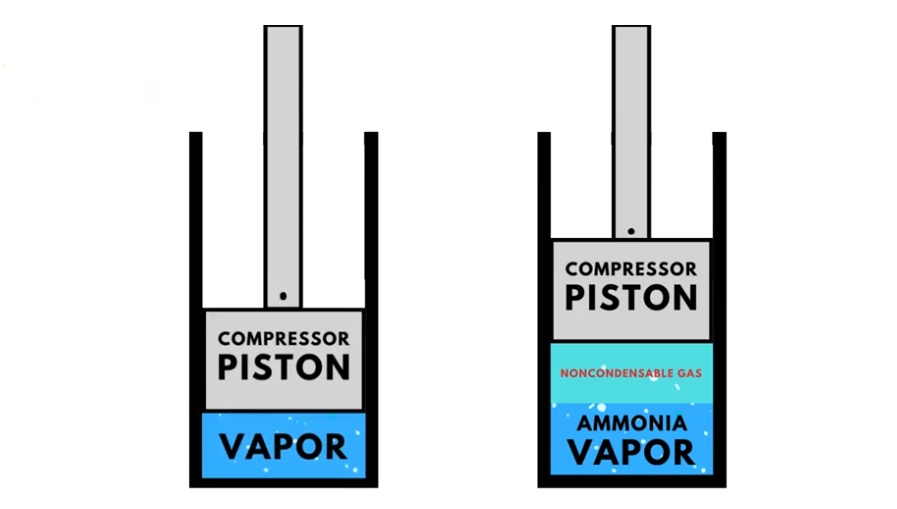
Noncondensable gases are mainly introduced in two ways:
First, when performing maintenance, equipment is opened to atmospheric conditions. If the equipment is not evacuated before placing it back into service, the air in the equipment will become trapped in the system as a noncondensable gas.
Second, systems that require low temperatures operate at vacuum pressures. This means that if there is a leak, rather than refrigerant leaving the system, air will be sucked into it.
“Daulton’s Law of Partial Pressures” states that the total pressure is the sum of the partial pressures. This means that if there is 10 psi of “Substance A” and 15 psi of “Substance B”, the total pressure will be 25 psi.
Daulton’s Law and the relationship between pressure and temperature at saturated conditions can be used to quantify the extent of noncondensable gases in a system.
Inside a condenser, the refrigerant rejects heat. This process desuperheats the discharge vapor and then condenses the vapor into liquid at a constant temperature. As this occurs, the refrigerant is said to be “saturated”. When a refrigerant is saturated, if the temperature is known, the saturation table can be used to determine the saturated pressure of the refrigerant.
Example:
Say there is an ammonia refrigeration system with a condensing temperature of 95ºF. This corresponds to a saturation pressure of 181 psig. However, while an operator was doing his daily rounds, he observed that the condensing pressure was 200 psig. Applying Daulton’s Law, the saturated ammonia pressure can be subtracted from the measured pressure to determine that there are 19 psig of noncondensable gases in the system.
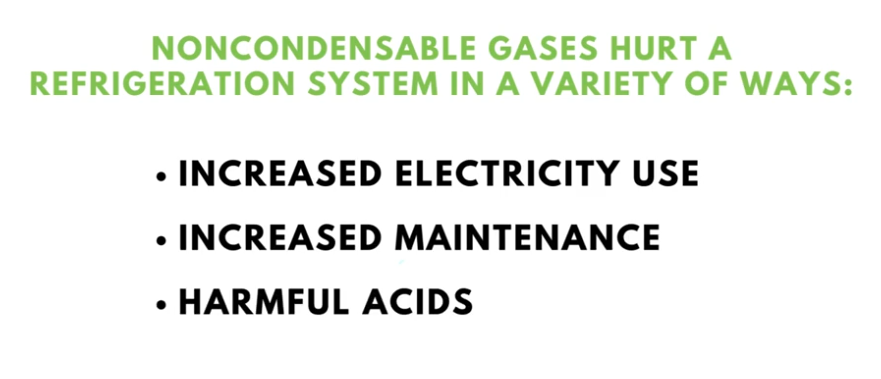
Noncondensable gases hurt a refrigeration system in a variety of ways:
- Electricity use will increase since the compressor must compress the refrigerant and noncondensable gas.
- Due to the increased total pressure in the system, the theoretical discharge temperature at the compressor outlet will be higher. This will increase wear and tear on the machine and break down the oil more quickly.
- Sometimes the water vapor in the air can react with the refrigerant to form acids that are harmful to the system.
Leave a Reply