
Refrigeration Cycle: Heat of Compression
Anyone that has operated a refrigeration system knows that a significant amount of energy is required to run a compressor. “Heat” and “energy” are measured using the same units, and much of the electrical energy required by the compressor is transformed into heat energy in the refrigerant vapor.
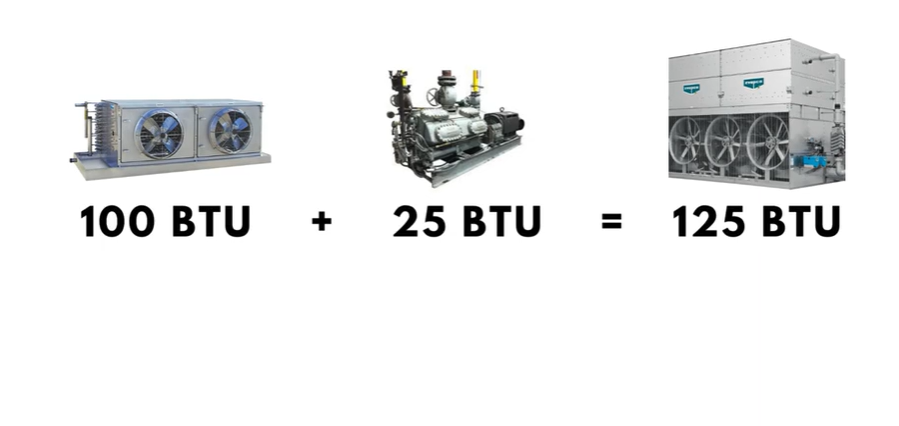
Think about it this way. When any vapor is compressed, the molecules are pushed closer together, which causes the temperature of the vapor to increase. The heat that is added during this process is called the “heat of compression” and must be accounted for when designing a system. As a rule of thumb, the heat of compression can be 20-25% of the heat absorbed in the evaporators.
This means that if 100 BTUs of heat were absorbed in the evaporators, the heat of compression could be another 25 BTUs. Therefore, the condenser would need to be sized to reject all 125 BTUs.
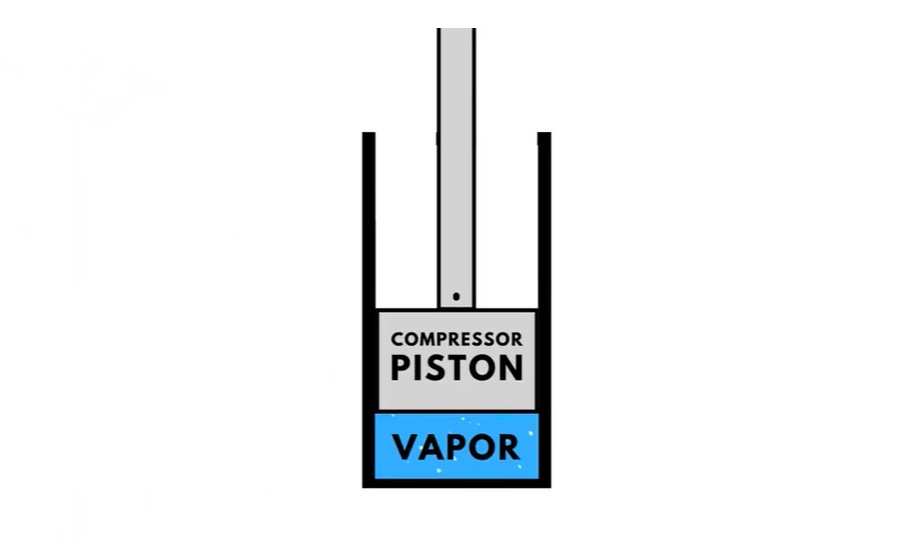
To illustrate this, imagine that there is a 100% efficient single-piston compressor that has no pressure losses and no heat transfer occurring through the walls of the compressor.
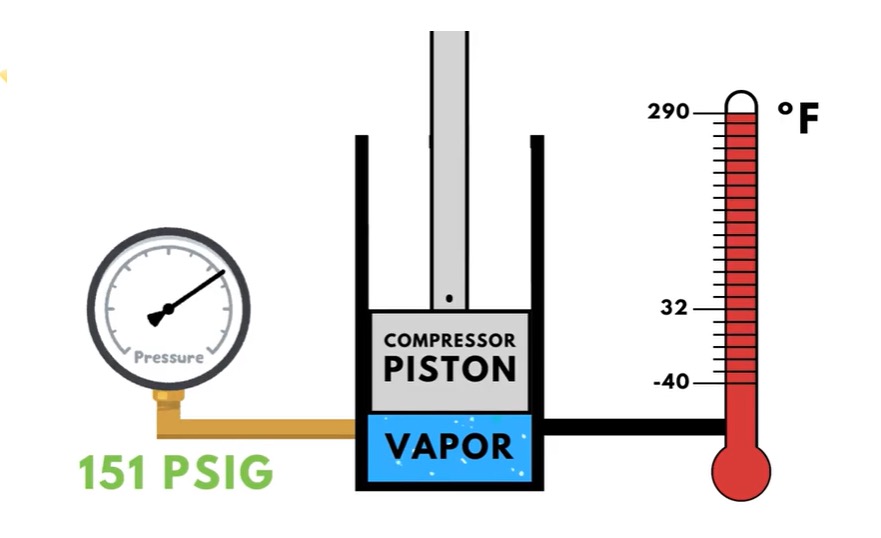
If there is one pound of -28ºF ammonia vapor, the corresponding pressure is 0 psig. The volume occupied, or the chamber size, therefore, must be 18 cubic feet. As the pound of ammonia is compressed, the volume occupied shrinks. To compress one pound of ammonia to 151 psig, the volume will need to be reduced to 1.8 cubic feet. Assuming isentropic compression, superheated refrigerant tables show that the theoretical temperature of the compressed vapor is 290ºF.
Leave a Reply