
Refrigeration Cycle: Refrigeration Condition Throughout the Cycle
A savvy refrigeration professional will not only understand the vapor compression cycle, but will also know the “condition” of the refrigerant throughout the system.
Let’s start with saturation. Whenever a substance changes from liquid to vapor or vice versa, it is said to be “saturated”. Additionally, a refrigerant is saturated when liquid and vapor coexist.
With that information, it is known that the refrigerant will be saturated in the following areas of the refrigeration cycle:
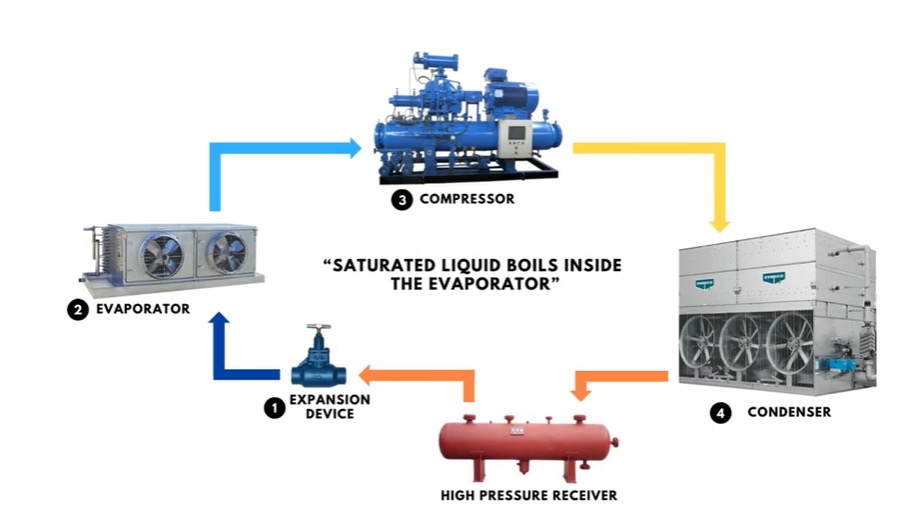
- Evaporator – Saturated liquid boils inside the evaporator.
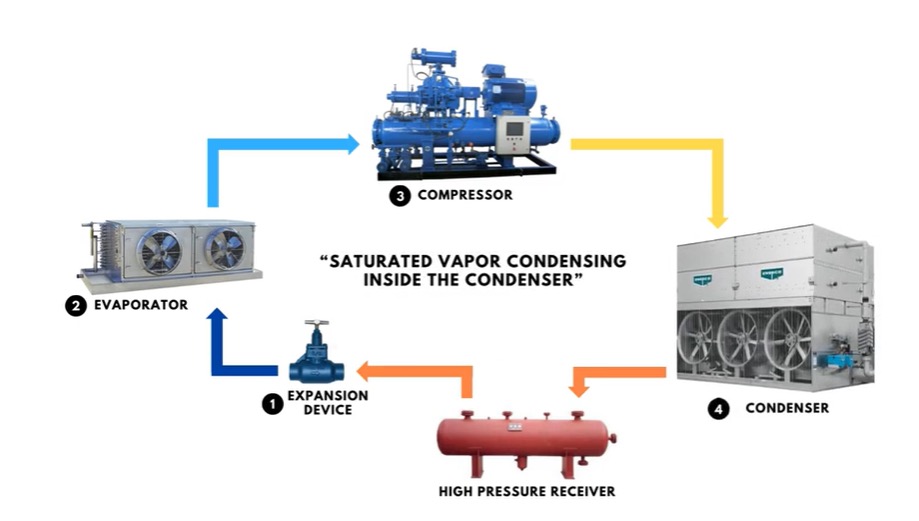
- Condenser – Saturated vapor condensing inside the condenser.
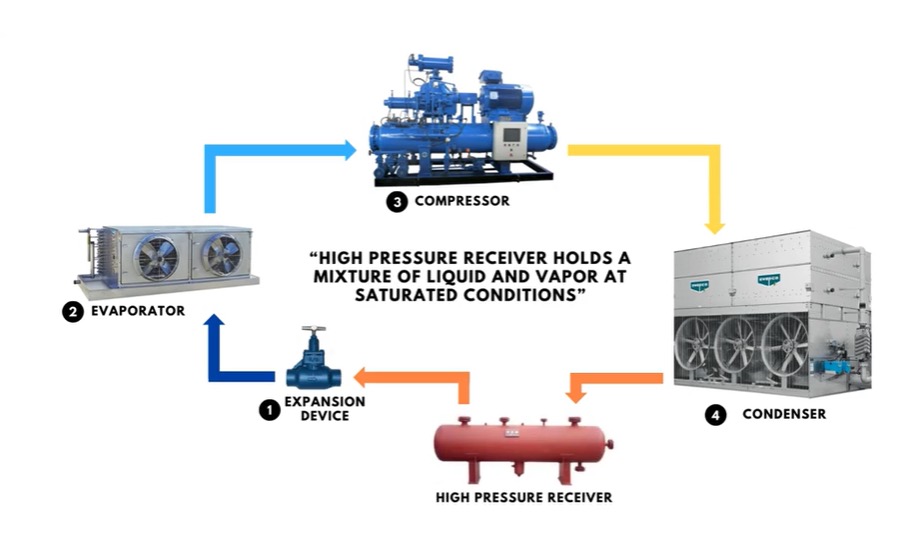
- High-Pressure Receiver – The high-pressure receiver holds a mixture of liquid and vapor at saturated conditions.
“Superheating” occurs when a vapor is heated beyond its boiling point. The heat of compression added to the refrigerant in the compressor results in a superheated vapor at the outlet of the compressor.
Additionally, sometimes a large heat load on the evaporator will result in all of the liquid boiling. Once that has occurred, every additional BTU will produce superheated vapor.
“Subcooling” occurs when a liquid is cooled below its boiling point. Some systems are designed with oversized condensers so that the liquid exiting the condenser is subcooled. Other systems utilize a separate heat exchanger called a “subcooler” to produce subcooled liquid.
Leave a Reply