
Refrigeration Cycle: Gravity Flooded Refrigeration System
A “gravity-fed”, or “flooded” refrigeration system has all of the same components as the direct expansion system, but utilizes an additional vessel.
Whereas the DX system piped the high-pressure liquid through an expansion device and directly into the evaporator, a flooded system is designed so that the liquid leaving the expansion valve is piped to a vessel called a “surge drum” or “accumulator”. The surge drum is located above the evaporator, which allows the low-pressure liquid from the vessel to be fed to the evaporator by gravity.
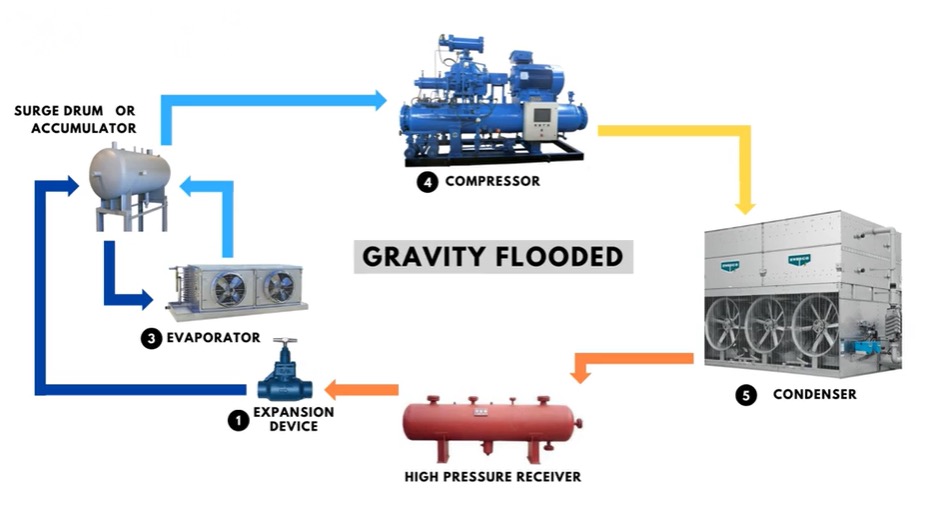
As heat is absorbed in the evaporator, the liquid will boil, forming vapor, which is returned to the surge drum. The vapor rises to the top of the surge drum, where it is piped to the compressor.
Flooded systems are employed, in part, so that the flash gas formed through the expansion device never passes through the evaporator. Instead, the flash gas enters the surge drum and is returned to the compressor. This means that 100% liquid is supplied to the evaporator, which is preferable.
Another advantage of flooded systems is that when multiple flooded evaporators are installed in the same system, they can be controlled at temperatures and pressures that are independent of each other. This allows for precise temperature control in different rooms, which is ideal for the fresh produce industry.
The downside of a flooded system is that, because each flooded zone requires a surge drum, the systems are more complex and expensive than direct expansion systems.
Leave a Reply