
Refrigeration Cycle: Direct Expansion Refrigeration System
A direct expansion, or DX, refrigeration system is the simplest of the refrigeration cycles. In a DX system high pressure liquid is supplied through an expansion device, directly into the evaporator, hence the name “direct expansion”. As the refrigerant absorbs heat in the evaporator, it boils as it transitions from a liquid to a vapor.
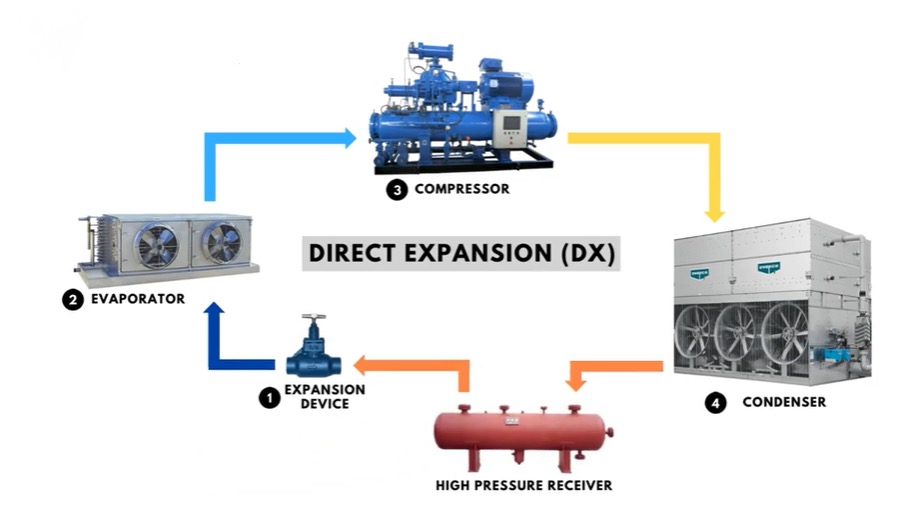
The vapor exiting the evaporator is piped to a compressor, which receives the low-pressure, low-temperature vapor and compresses it. The compression process reduces the volume occupied by the refrigerant, which results in a higher pressure as the refrigerant exits the compression.
Additionally, when refrigerant vapor is compressed, the temperature of the vapor increases. This is called the “heat of compression” and is added to the heat already absorbed in the evaporator.
From the compressor, the high-pressure, high-temperature vapor is piped to a condenser, which is a heat exchanger whose purpose is to reject the heat gained in the evaporator and compressor to a place where the heat can do no harm. Typically, the heat is rejected to the atmosphere. Inside the condenser, the refrigerant vapor is first cooled to its boiling point and then condensed at a constant temperature.
The liquid refrigerant exiting the condenser typically drains into a high-pressure receiver. Theoretically, a vapor compression system does not require a high-pressure receiver, but due to fluctuations in load and changes in the ambient temperature, a receiver provides storage for refrigerant not being used at any given moment.
The high-pressure liquid from the receiver is piped to the expansion device, where we started our process.
The main advantage of a DX system is its simplicity, which typically results in savings when designing and installing a system. The downside is that as the warm liquid passes through the expansion device, some will evaporate. The vapor that forms is called “flash gas” and is unwanted since the vapor must travel through the evaporator, but has no potential to absorb latent heat.
Leave a Reply