
Refrigeration Cycle: Evaporative Condensers
Evaporative condensers are the most common type of condenser employed in industrial refrigeration systems. By utilizing a combination of air and water, evaporative condensers can efficiently reject heat to the atmosphere. This category of condenser integrates the principles of evaporative cooling and therefore, condenses the superheated vapor from the compressor more efficiently than traditional air-cooled or water-cooled condensers. By leveraging the latent heat of vaporization of water, evaporative condensers can achieve effective heat rejection with lower energy and water consumption compared to standalone water-cooled systems.
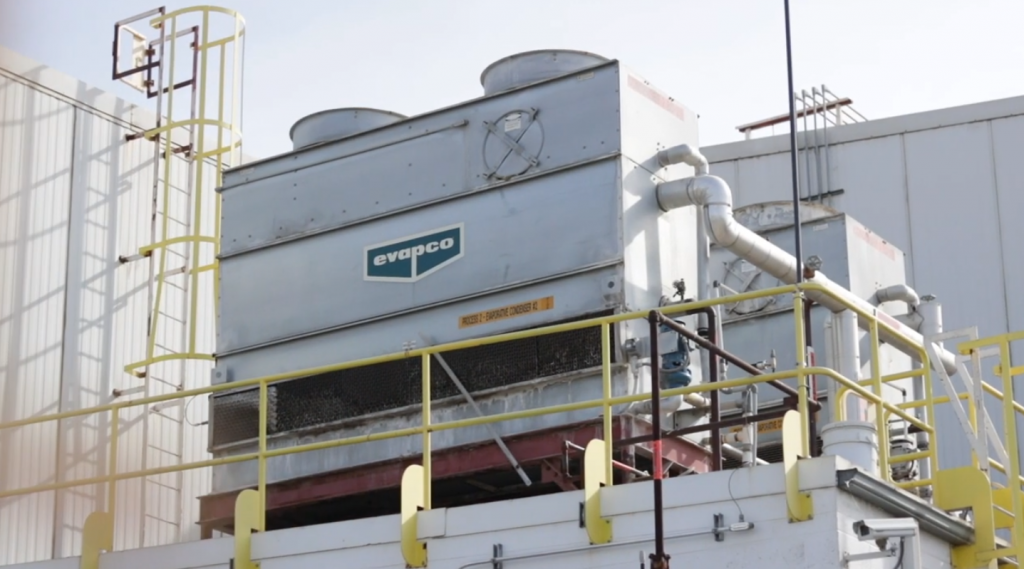
Every evaporative condenser has the following key components:
Connections:
Each condenser will have at least one inlet connection to receive superheated vapor and one outlet connection where liquid exits the condenser.
Coil:
The refrigerant flows through a series of heat exchange coils made of durable materials like galvanized or stainless steel. These coils provide the necessary surface area for effective heat transfer.
Water Distribution System:
Water is sprayed or distributed over the exterior of the heat exchange coils. This water enhances heat transfer and facilitates evaporative cooling.
Fans:
Fans move ambient air across the coils and sprayed water, accelerating the evaporation process and carrying away heat from the refrigerant.
Mist/Drift Eliminators:
Located near the air outlets, the mist eliminators minimize water loss by capturing water droplets from the air stream, reducing drift, and conserving water.
Pump:
A pump circulates water from the basin to the spray nozzles, ensuring continuous wetting of the heat exchange coils.
Water Basin:
A collection basin or sump at the base of the condenser holds the recirculating water. The sump is configured with a ball float valve to provide make-up water to replace what was lost by evaporation.
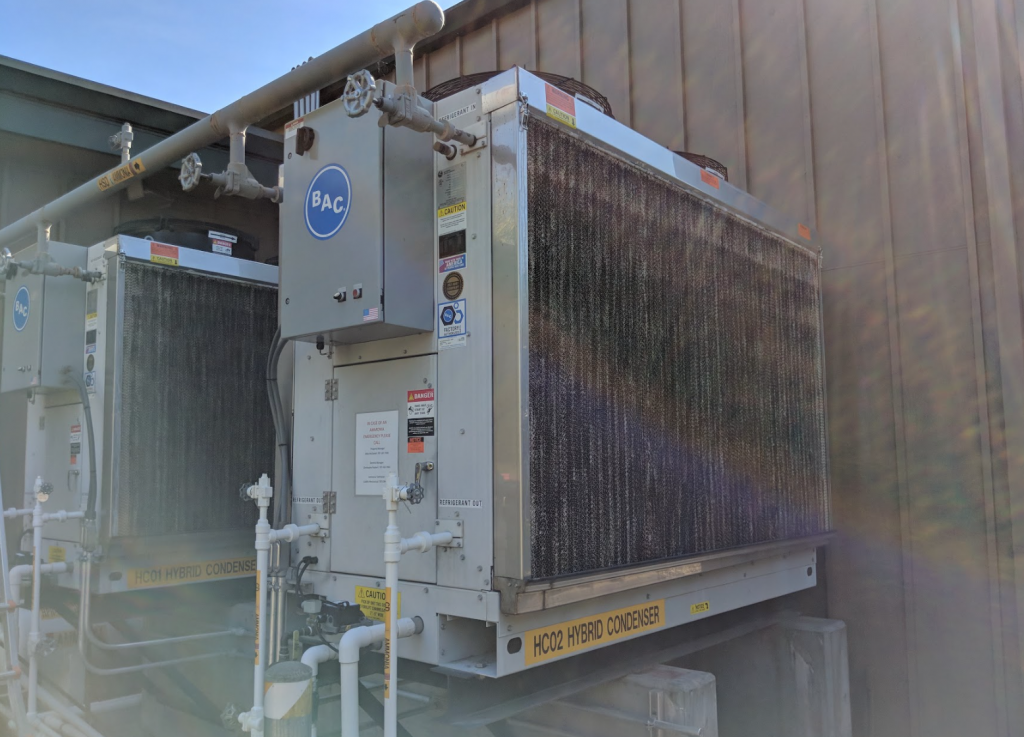
An “adiabatic condenser” is a hybrid condenser that combines features of both air-cooled and evaporative condensers. When ambient temperatures are low, adiabatic condensers can operate in “dry mode” where all heat exchange is accomplished through air movement without the assistance of water. When ambient temperatures rise, the condenser will adjust to “adiabatic mode” where a water distribution system wets adiabatic pads, causing air drawn through them to cool via evaporation. The pre-cooled air then passes over the coils, enhancing the condenser’s cooling capacity and maintaining efficient refrigerant condensation even in high-temperature environments.
Leave a Reply