
Properties of Refrigerants: Interpolation

When looking up information in a saturated or superheated table, sometimes the reference value falls between two rows in the table. When this occurs, engineers must either approximate the value or interpolate between two available rows. In thermodynamics, interpolation is a way to “fill in holes” in tables. For example, in this saturated table, the thermodynamic properties for ammonia at 15 and 20 degrees Fahrenheit are displayed.
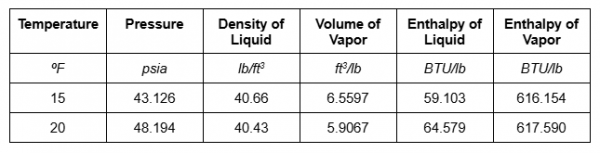
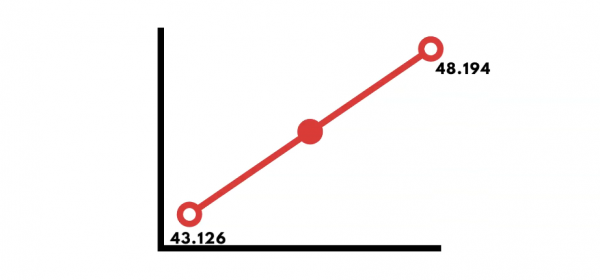
But what if we desire to know the pressure of ammonia at 17.5ºF? Since that is not a row in the table, we could either approximate the pressure by using the closest value, or we could interpolate between the 15ºF and 20ºF rows.
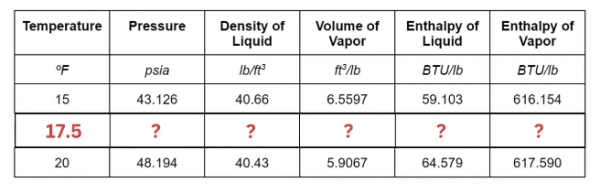
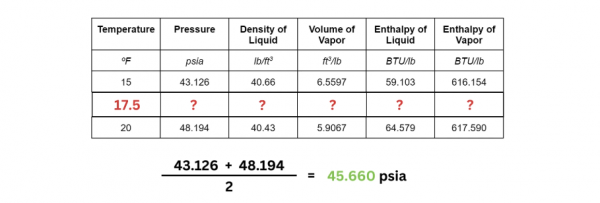
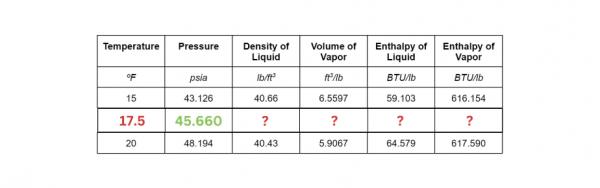
Since 17.5 is the average of 15 and 20, we can interpolate that the pressure at 17.5ºF would be 45.660 psia, which is the average of the pressures corresponding to 15º and 20º.
Mathematically, interpolation is more complicated when the desired value is not halfway between two points on a table, but linear interpolation can be used with the application of simple algebra and what we know about the slope of a line. When using linear interpolation, we assume that a straight line connects the distance between two points. Then, applying simple math allows us to approximate the value of a data point that lies on the line.
Leave a Reply