
Refrigeration Cycle: Pressure Drop
Just as the second law of thermodynamics states, there must be a temperature difference for heat exchange to occur, so there must be a pressure difference for fluid flow to occur. Because of friction, as a fluid moves through a pipe, it will lose some pressure, which results in a ΔP. ‘Δ’ (pronounced “Delta”) is a Greek letter that is commonly used to express differences between parameters, such as “ΔP” for pressure differences and “ΔT” for temperature differences.

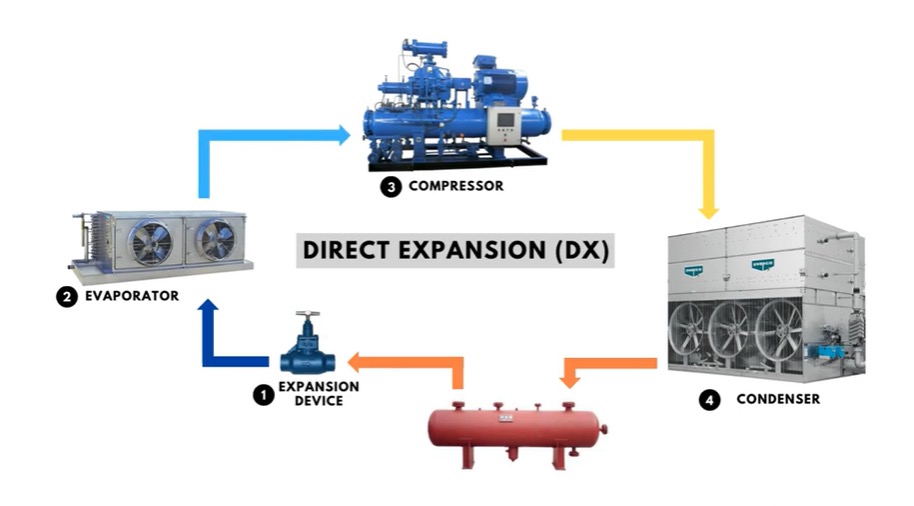
In a refrigeration context, the lowest pressure in the system always occurs at the inlet to the compressor and the highest pressure at the compressor outlet. Flow will always occur from a higher pressure to a lower pressure.
Since refrigerant vapor flows from the outlet of the evaporator to the compressor, the pressure at the evaporator must be higher. To help reinforce this, consider that if the compressor suction pressure were higher than the evaporator pressure, the refrigerant would be flowing backward through the cycle!
Example:
Say there is an evaporator operating at 45 psig, and the gauge at the compressor suction is 42 psig. What is the pressure difference, or ΔP?
This is fairly easy to see that there is a 3 psi pressure difference between the evaporator and the compressor suction. This pressure difference is due to the piping connecting the evaporator to the compressor. Notice that it would not change the answer if the pressure drop were calculated using absolute units. 59.7 psia – 56.7 psia = 3 psia. When calculating a change in pressure, either gauge or absolute units can be used.
Many factors contribute to pressure differences in a system:
- First, the diameter of the pipe. The larger the diameter, the less pressure drop there will be.
- Second, the length of the pipe. The longer the pipe length, the greater the pressure drop will be.
- Third, pipe fittings and valves. Whenever a fluid flows through a valve or around a ‘90’, there are pressure losses as the fluid changes direction. This results in a pressure drop.
- Finally, the velocity of fluid flow will affect the pressure drop. The faster the fluid is flowing, the greater the pressure drop will be.
Leave a Reply