
Refrigeration Cycle: Changing the Boiling Point
Opening a thermodynamics textbook, it is stated that the purpose of a refrigeration system is to maintain a cold region at a temperature below the temperature of its surroundings. This can be accomplished by employing a vapor compression refrigeration system.
To understand how a vapor compression refrigeration system works, let’s start with a familiar substance…“water”.
If there is a container of water on a stove and the burner turns on, it is known intuitively that the temperature of the water will increase. Experiments have shown that water’s boiling point is 212ºF. Two important things occur at the boiling point. First, the water begins to change states from liquid into vapor, or steam. Second, the temperature of the water is constant while this change of state occurs.
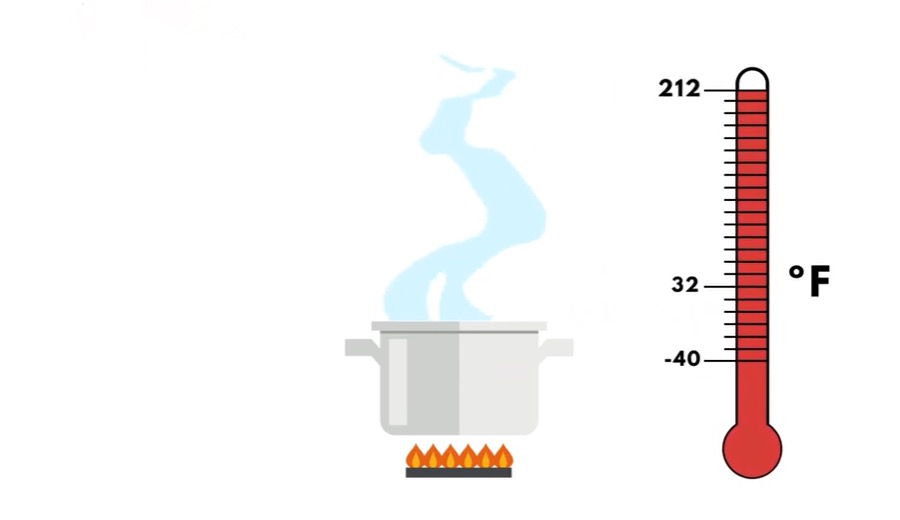 It turns out that stating that “water’s boiling point is 212ºF” is not entirely accurate. Water’s boiling point is 212ºF, but only at sea level, where the atmospheric pressure is 14.7 psia. This is an important fact. The boiling point of water, or any substance, is dependent on the pressure of the substance. In other words, when a substance is at its boiling point, the temperature and pressure of the substance are dependent.
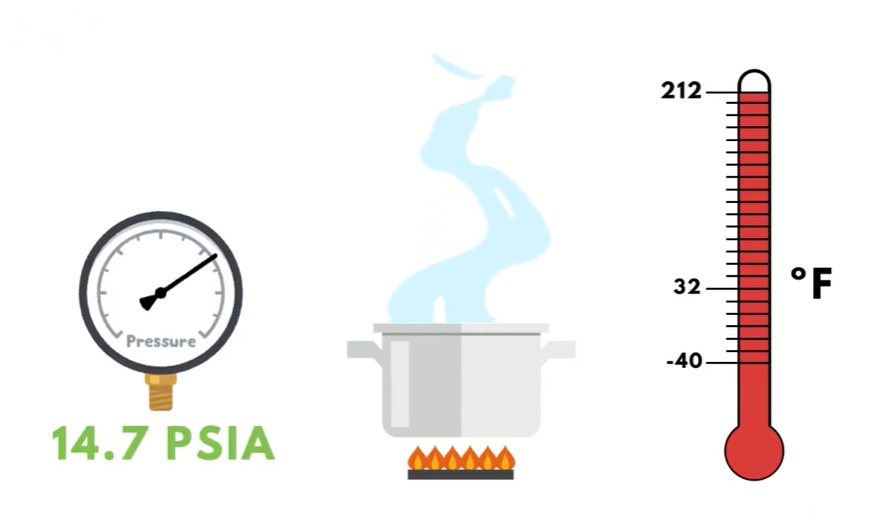
What happens when the pressure of water is changed and then heat is applied? Experiments have shown that changing the pressure will have a direct effect on the boiling point.
For example, a meal will cook differently at a higher elevation because the water will boil differently. This can be attributed to the change in atmospheric pressure. At a cabin with an elevation of 6,000 feet above sea level, the atmospheric pressure is 11.77 psia, which reduces the boiling point to 200.8ºF. This means that the water will begin boiling sooner, but it will take longer to cook something with the boiling water since the temperature is lower. 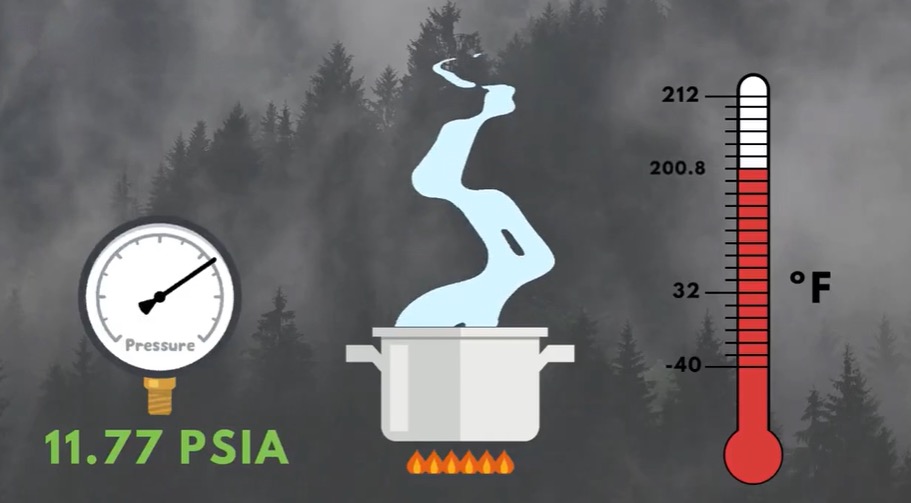
What does this have to do with the refrigeration vapor compression cycle?
Now, go back to the original container of water and seal it so that the pressure in the container can be manipulated with a compressor or a vacuum pump. Now, the boiling point of water can be adjusted accordingly.
If the pressure on the container is raised to 20 psia, the water will boil at 228ºF.
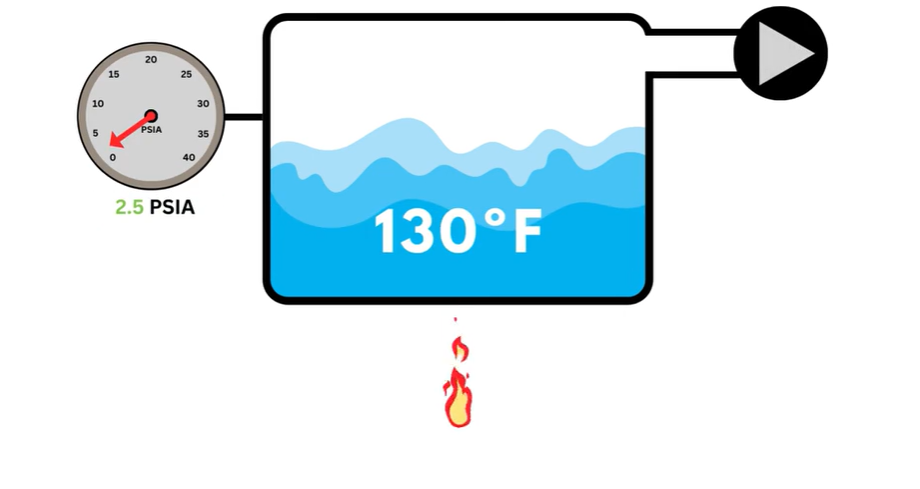
Lowering the pressure in the container to 2.5 psia can cause the water to boil at 130ºF.
Pulling a hard vacuum on the container, by reducing the pressure to 0.12 psia, will lower the boiling point of water down to 40ºF. Imagine that…water boiling at a temperature that is only 8ºF higher than the freezing point of water at sea level.
Working through these examples has proven several points that are important for refrigeration. First, changing the pressure of a substance can also change its boiling point. Second, there is a range of boiling points for any given substance. Using water, even with a hard vacuum, the lowest boiling point realistically achievable is 40ºF. Since most refrigeration applications require a temperature below 40ºF, water is not a great refrigerant choice, but ammonia, carbon dioxide, and other synthetic refrigerants have excellent properties for refrigeration applications.
Leave a Reply