
Properties of Refrigerants: Refrigerant Safety Groups
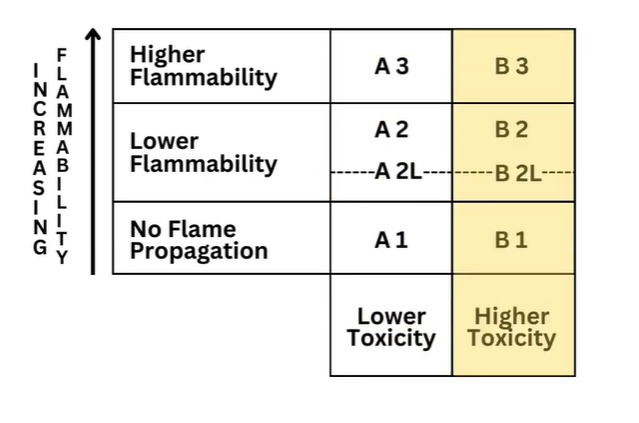
ASHRAE Standard 34 is titled “Designation and Safety Classification of Refrigerants”. Among other things, this standard assigns each refrigerant a safety group classification based on the refrigerant’s flammability and toxicity. Refrigerants with low toxicity are given a rating of ‘Class A’, while refrigerants with higher toxicity are assigned ‘Class B’. According to Standard 34, refrigerants with an “Occupational Exposure Limit” or OEL of 400 ppm or greater are ‘Class A’.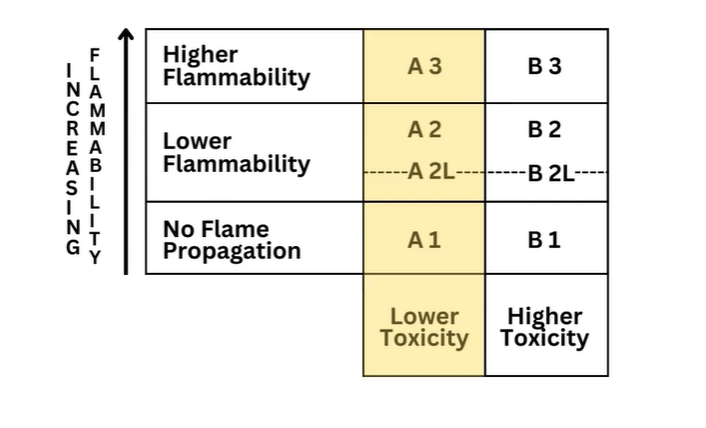 Refrigerants with an OEL less than 400 ppm are ‘Class B’.
  OEL is defined as the time-weighted average concentration for a normal eight-hour workday and a 40-hour workweek to which nearly all workers can be repeatedly exposed without experiencing adverse effects. Ammonia has an OEL of 25 ppm, so it is a Class B refrigerant relative to toxicity.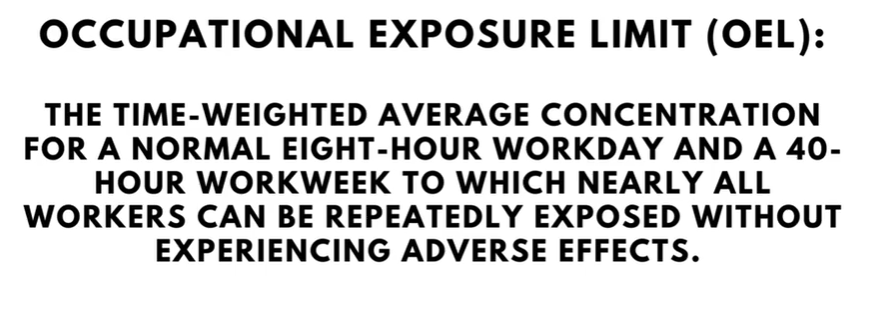
Flammability is rated numerically 1 through 3. A ‘Class 1’ rating means that the refrigerant is essentially incapable of flame propagation.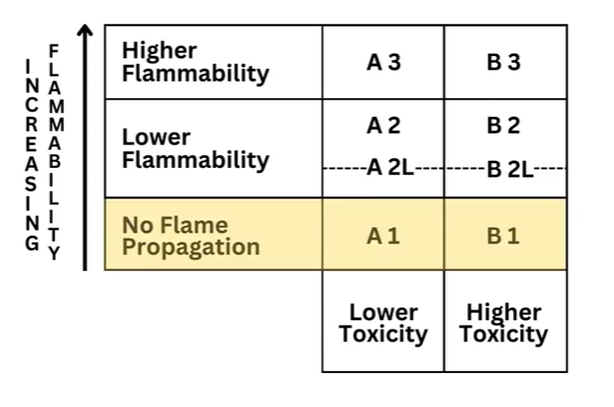 A rating of ‘Class 2’ means the refrigerant can burn and has a lower flammability limit, or “LFL” greater than 0.0062 pounds per cubic foot at 73.4ºF and standard atmospheric pressure. Class 2 refrigerants must have a heat of combustion of less than 8169 BTUs per pound.
 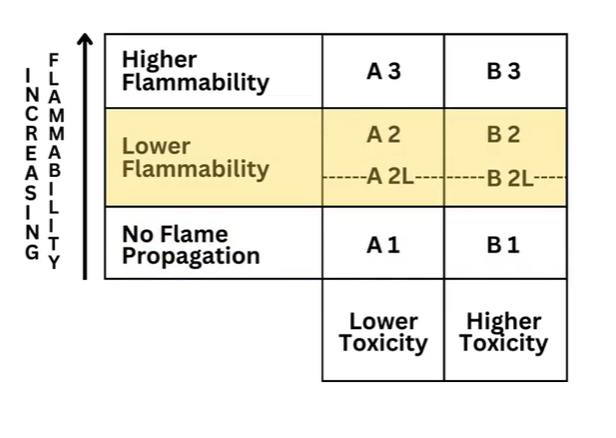 ‘Class 3’ means the refrigerant is considered highly flammable, with an LFL less than or equal to 0.0062 pounds per cubic foot and a heat of combustion greater than or equal to 8169 BTU per pound.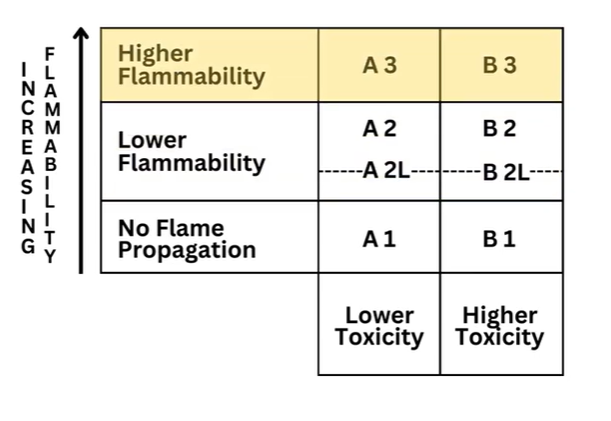
The 2010 edition of Standard 34 introduced a subcategory of Class 2L, which is a lower flammability risk than ‘Class 2’ but greater than ‘Class 1’. To be categorized as Class 2L, the refrigerant must have a burning velocity of no more than 3.9 inches per second at 73.4ºF and standard atmospheric pressure.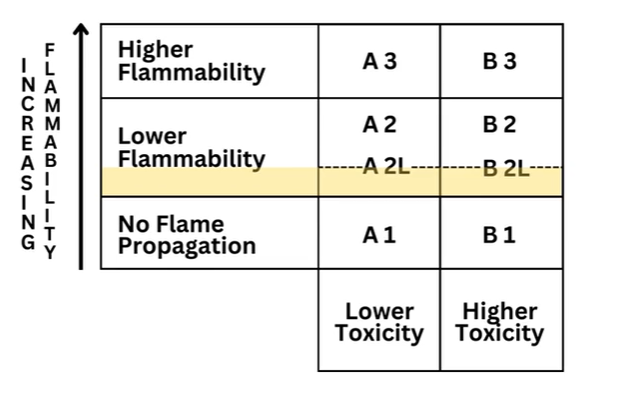
Ammonia is rated ‘Class B2L’, meaning it is toxic and somewhat flammable. R-22 and carbon dioxide are rated ‘A1’ because they are neither toxic nor flammable.
Leave a Reply