
Fundamentals of Refrigeration: Ton of Refrigeration
Any refrigeration professional must understand the most common unit used in refrigeration, the “ton of refrigeration”. To properly explain what a “ton” is in a refrigeration context, studying refrigeration history is helpful. When the refrigeration vapor compression cycle was first invented, the most common application of a refrigeration system was making blocks of ice. Once frozen, the ice could be transported in insulated refrigerated railcars to provide cooling at a different location.

A “ton” is a unit of mass that is equivalent to 2,000 pounds. It became a common convention to rate a refrigeration system by its ability to freeze one-ton blocks of ice.
Example:
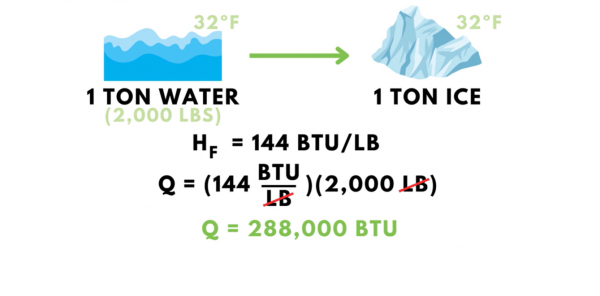
It is known that the latent heat of fusion of water is 144 BTUs per pound. That means that 144 BTUs must be removed from one pound of 32ºF water to make 32ºF ice. Since the problem has one-ton blocks of ice, that means that 288,000 BTUs must be removed from one ton of water to make a one-ton block of ice.
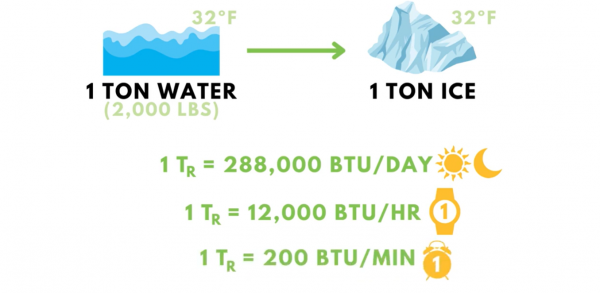
It became convenient to rate systems by the number of one-ton blocks of ice that they could make in a 24-hour day. In other words, a one-ton refrigeration system could remove 288,000 BTUs from 32ºF water in 24 hours.
This means that a “ton of refrigeration” is a “rate of heat transfer”. A rate is a property that is divided by a unit of time. One ton of refrigeration is equal to 288,000 BTUs per day, 12,000 BTUs per hour, and 200 BTUs per minute.
This is an important concept. When you hear someone say “This is a 200-ton system”, that means that the system is capable of removing heat at a rate of 200 tons or 2,400,000 BTUs per hour. Knowing the “rate of heat transfer” is much different than knowing the amount of heat that must be removed, which is dependent on many factors.
Leave a Reply