
Fundamentals of Refrigeration: Latent Heat
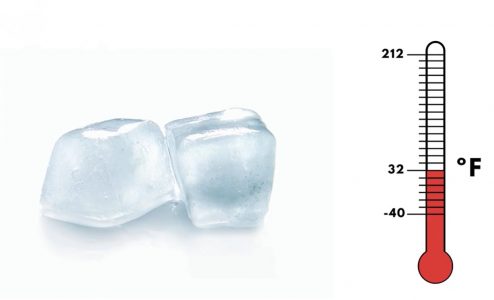
When a substance changes state from solid to liquid, or from liquid to vapor, it is said to undergo a phase change. Interestingly, as heat is applied or removed from a substance during a phase change, the temperature of the substance remains constant. For example, when a block of ice melts to form water, the temperature is constant at 32 degrees Fahrenheit.
This form of heat energy, which cannot be measured with a thermometer, is called “latent heat”. The word “latent” has its origin in the Latin language and means “hidden”. It is said to be hidden because it cannot be measured with a thermometer. Latent heat is fundamental to understanding refrigeration because of the large amount of heat that can be absorbed or rejected during a phase change.
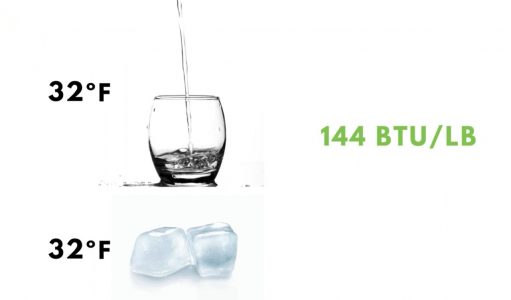
Latent heat is categorized by the type of phase change occurring. The “latent heat of fusion” is the heat rejected from a substance as it changes state from a liquid to a solid. The term “latent heat of fusion” also applies to the reverse process, where heat is added to cause a solid to melt and become liquid. The latent heat of fusion of water is 144 BTUs per pound. This means that 144 BTUs must be removed from one pound of 32 degrees Fahrenheit water to form 32 degrees Fahrenheit ice.
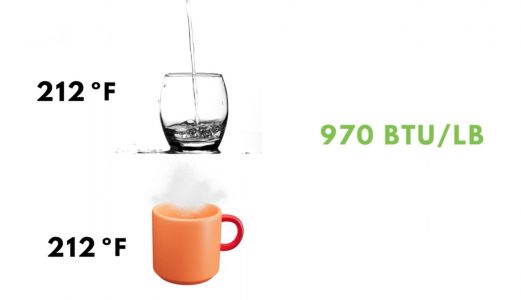
The “latent heat of vaporization” is the same concept applied to the phase change from liquid to vapor. For water, the latent heat of vaporization is 970 BTUs per pound. This means that 970 BTUs are required to boil one pound of 212 degrees Fahrenheit water to form 212 degrees Fahrenheit steam.
The “latent heat of condensation” is applied to the reverse process, which results in a substance transitioning from a vapor to a liquid. The quantity of heat applied or removed is equal during vaporization and condensation, so the values of the “latent heat of vaporization” and the “latent heat of condensation” are the same for the same substance.
The formula used to calculate the heat required to change the state of a substance is called the “latent heat equation” and is expressed as ‘Q’ equals ‘M’ multiplied by ‘h’. Where ‘Q’ is the heat quantity measured in BTUs, ‘M’ is mass, measured in pounds, and ‘h’ is the specific enthalpy of the substance, measured in BTUs per pound.

The latent heat equation can be applied anytime there is a phase change of a substance that does not involve a temperature change, or sensible heat.
Example 1:
How many BTUs are required to change 3 pounds of 212ºF water into 212ºF steam?
To solve this problem, it is important to recognize that the boiling point of water is 212ºF. Since the water starts at its boiling point, all of the heat energy added to the water will contribute to changing the state from liquid to vapor. The latent heat equation is perfect for this scenario. The mass is given to us and is 3 pounds. The problem states that water is being heated, so it is necessary to know that the latent heat of vaporization of water is 970 BTUs per pound. Once these values are plugged into the equation, it is determined that 2,910 BTUs are required to change 3 pounds of 212ºF water into 212ºF steam.
Example 2:
It takes 1,000 BTUs to completely melt an unknown mass of 32ºF ice into 32ºF water. What is the mass?
To solve this problem, first, rearrange the equation to solve for ‘M’, or mass. Whatever is done to one side of the equation must also be done to the other side.
The new equation is ‘M’ equals ‘Q’ divided by ‘h’. Since the problem states that ice is being melted, it’s important to know that the latent heat of fusion for ice is 144 BTUs per pound. Now, simply plug the given values into the equation to find that the mass of ice is 6.94 pounds.
Leave a Reply