
Fundamentals of Refrigeration: Pressure
Pressure is the measurement of a force applied over an area. The equation to calculate pressure is Pressure equals Force divided by Area.
Imagine that a 200-pound man stood on top of a table that has a 10 square foot area. Assuming the man’s weight could be evenly distributed across the table, the pressure exerted on the table would be 20 pounds per square foot.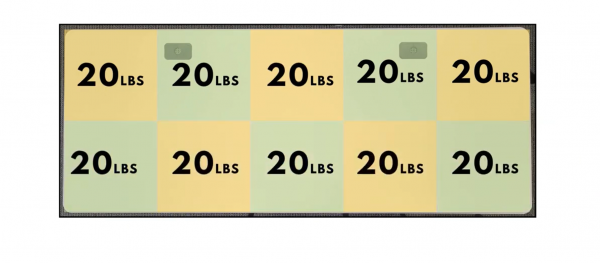
However, pressure is typically measured in pounds per square inch, so a unit conversion is needed.
Example: One square foot is equivalent to 144 square inches, so in this problem, the answer will be multiplied by one square foot over 144 square inches, which results in 0.14 pounds per square inch or psi.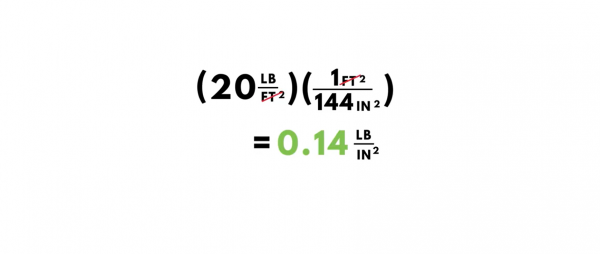
Example: What force is required to exert a 30 psi pressure on an area of 10 square inches?
In this problem, the pressure and area are given, and the force is unknown. Let’s rearrange the equation to solve for “force”. To isolate ‘F’, both sides of the equation will be multiplied by ‘A’. Now it is obvious that the force equals pressure times area.
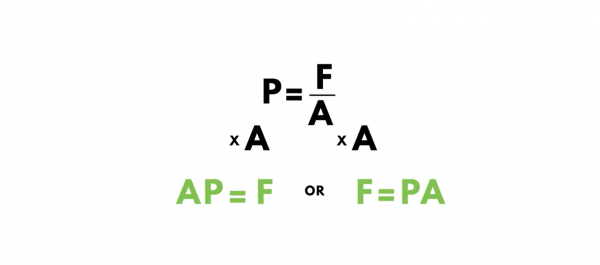
The last step is to multiply 30 pounds per square inch by 10 square inches. The force required to generate 30 psi over a 10 square-inch surface is 300 pounds.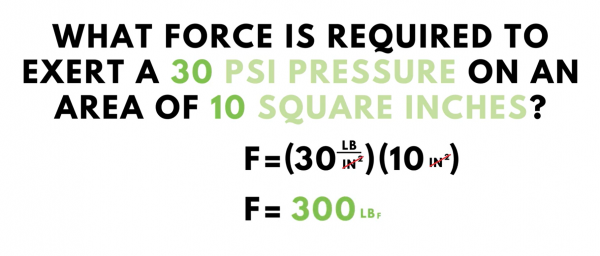
Leave a Reply