
Refrigeration Cycle: Building a Vapor Compression System
Imagine there was a container with an infinite amount of saturated refrigerant, and this refrigerant was both non-toxic and environmentally friendly.
Connecting this container to a compressor inlet would allow pressure control inside the container to a desired setpoint. Since the refrigerant is saturated, adjusting the pressure also changes the refrigerant’s boiling temperature. This allows for the selection of a compressor that can manipulate the pressure to achieve a refrigerant temperature suitable for cooling. Because the refrigerant is non-hazardous, the compressor’s discharge can be directed to the atmosphere.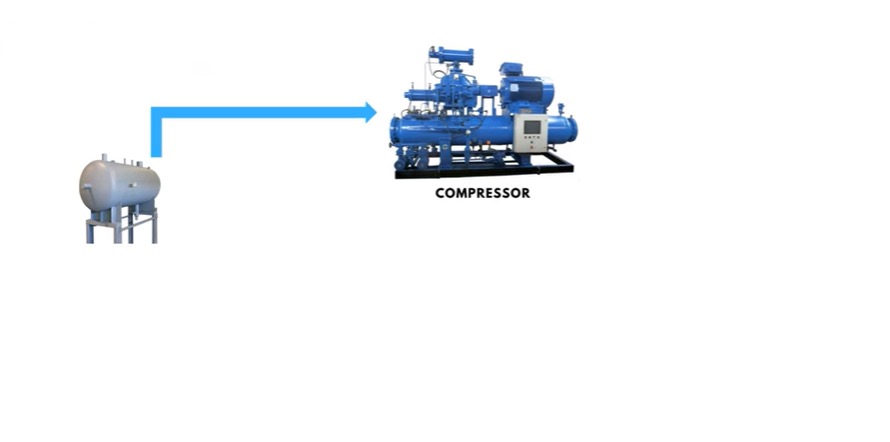
Now that there is an infinite supply of saturated liquid refrigerant at a desired low temperature, the refrigerant can simply be piped from our container to a heat exchanger where cooling is desired. As the saturated liquid absorbs heat from another substance inside the heat exchanger, it will cause the refrigerant to boil, which will occur at a constant temperature equal to the temperature inside the container. The refrigerant vapor generated is non-hazardous, so as it leaves the heat exchanger, it can simply be vented to the atmosphere. This is a form of refrigeration!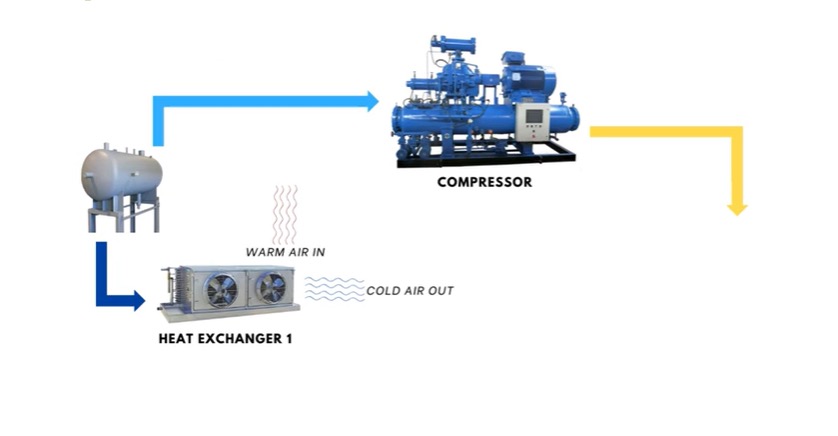
Unfortunately, many of the assumptions in this example are quite problematic. First, there is no such thing as an infinite container. Second, even if there was a refrigerant that was completely non-toxic and environmentally friendly, no refrigerant is “free”, so venting directly to the atmosphere is unacceptable.
Instead of venting the vapor from the evaporator to the atmosphere, install a pipe that connects the outlet of the evaporator back to the original container. The vapor will enter the container and then pass through to the suction of the compressor.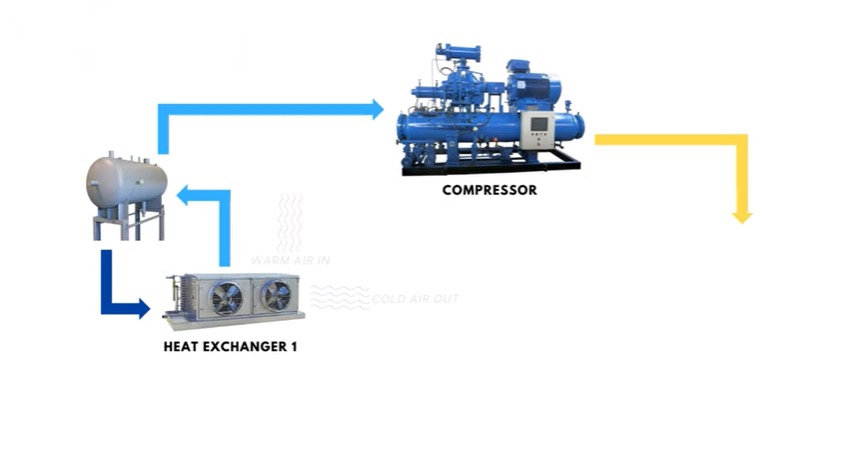
There is still the issue of the compressor discharge. The current configuration has the “system” discharging to the atmosphere. Instead of doing that, employ a second heat exchanger that connects to the outlet of the compressor. Because the refrigerant leaving the compressor is superheated vapor, the vapor will be able to be cooled and condensed if there is a cooler substance to exchange heat with. If cool ambient air is passed through the heat exchanger, the heat in the refrigerant vapor will be rejected into the air. This will cause the air temperature to increase, while the superheated vapor is cooled and then condensed into a saturated liquid.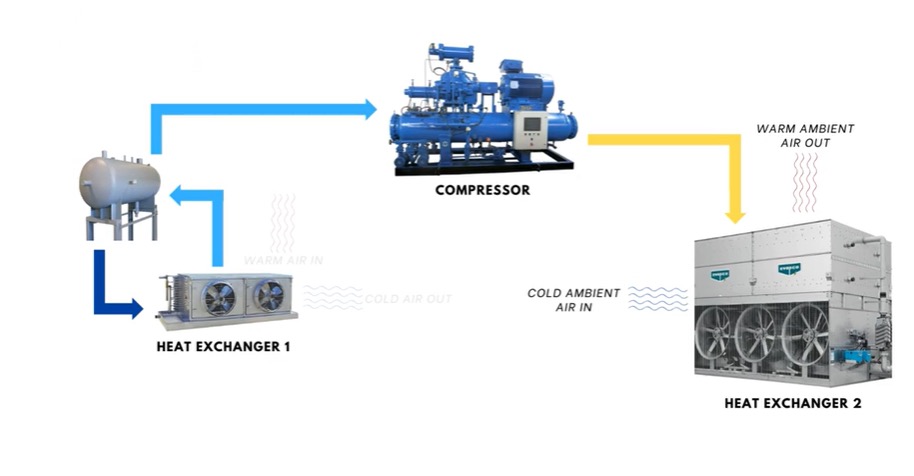
This has not solved the problem because there is still refrigerant venting directly to the atmosphere. However, by employing the second heat exchanger, the state of the refrigerant at the point of discharge is able to change from vapor to liquid.
Since the liquid leaving the second heat exchanger is at a higher pressure than the original container, the liquid can be piped back into the container. By placing an obstruction in the pipe, which is called an expansion device, the refrigerant entering the container will be at the container pressure. There will no longer be any refrigerant venting to the atmosphere!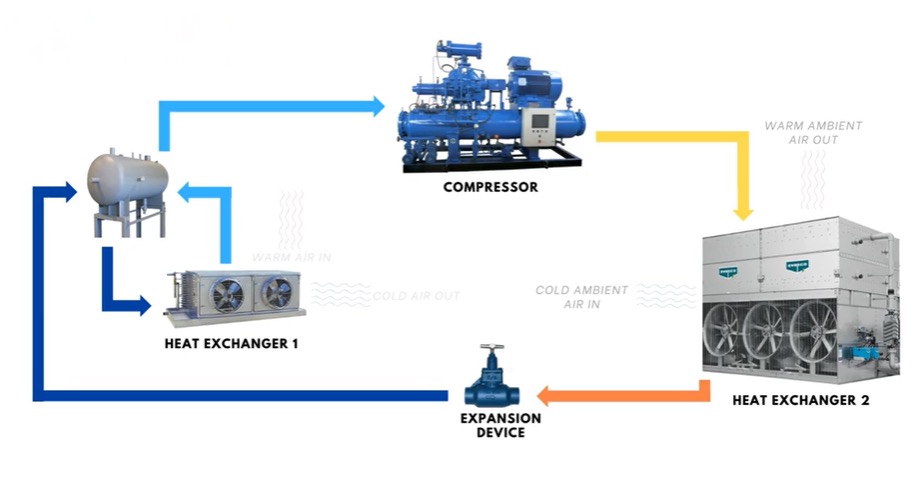
As a final step to simplify the system, the original container can be removed altogether. Since the refrigeration system is a “cycle”, no container is needed at all. All of the refrigerant that is boiled in the first heat exchanger is compressed, then condensed in the second heat exchanger, and finally supplied back to the first heat exchanger through an expansion device.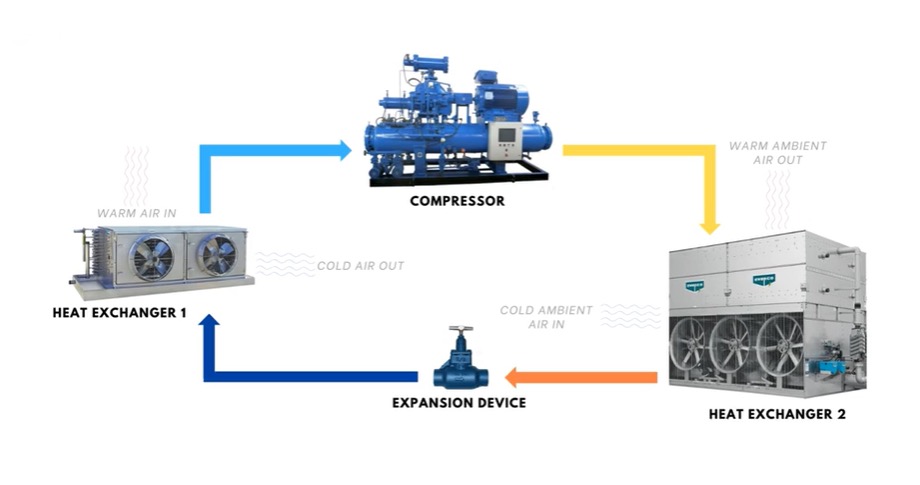
This is a vapor compression refrigeration system.
With this depiction in mind, a vapor compression system achieves refrigeration by manipulating the pressure of a refrigerant to reduce the temperature of the refrigerant in order to achieve a desired lower temperature in another substance.
Leave a Reply